
Safety Rate
Starting a family should feel like a joyful chapter, and for many women, a little guidance is all it takes to get there. At Fatima Fertility, our approach to female infertility treatment is built on clear communication, careful testing, and a plan made just for you. Every woman’s body is different, so we take time to understand your history before we suggest any next step.
Female infertility means a woman has not been able to get pregnant after a year of trying without protection, or after six months if she is over 35. It can happen for many reasons, from how the ovaries release eggs to how the uterus and fallopian tubes work. This does not mean pregnancy is impossible; it usually means the body needs a small correction, which is exactly what proper female infertility treatment is designed to provide. Many women who come to us with this concern go on to carry a healthy pregnancy once the right cause is found and addressed. Understanding what is happening inside your body is the first real step toward a solution.
There are several reasons a woman may find it hard to conceive, and often more than one factor plays a role. Knowing the exact cause helps us choose the most suitable path forward, rather than a one-size-fits-all plan. Below are the most common causes we see and treat regularly.
Ovulation disorders happen when the ovaries do not release an egg regularly or at all. This can be caused by hormone imbalances, stress, sudden weight changes, or certain thyroid conditions. Women with ovulation disorders often notice irregular or missed periods, which is usually the first clue. The good news is that ovulation problems are one of the most treatable causes of infertility, often responding well to medication. Identifying this cause early makes the overall female infertility treatment process shorter and simpler.
PCOS is a hormonal condition where the ovaries develop many small fluid-filled sacs and do not release eggs on a regular schedule. It is one of the most common causes of infertility in women and can also bring symptoms like acne, extra hair growth, or weight gain. PCOS does not mean you cannot get pregnant; it simply means your body needs help managing hormone levels and encouraging regular ovulation. With the right combination of lifestyle changes and medicine, many women with PCOS conceive successfully. We monitor your response closely and adjust the plan as your body responds.
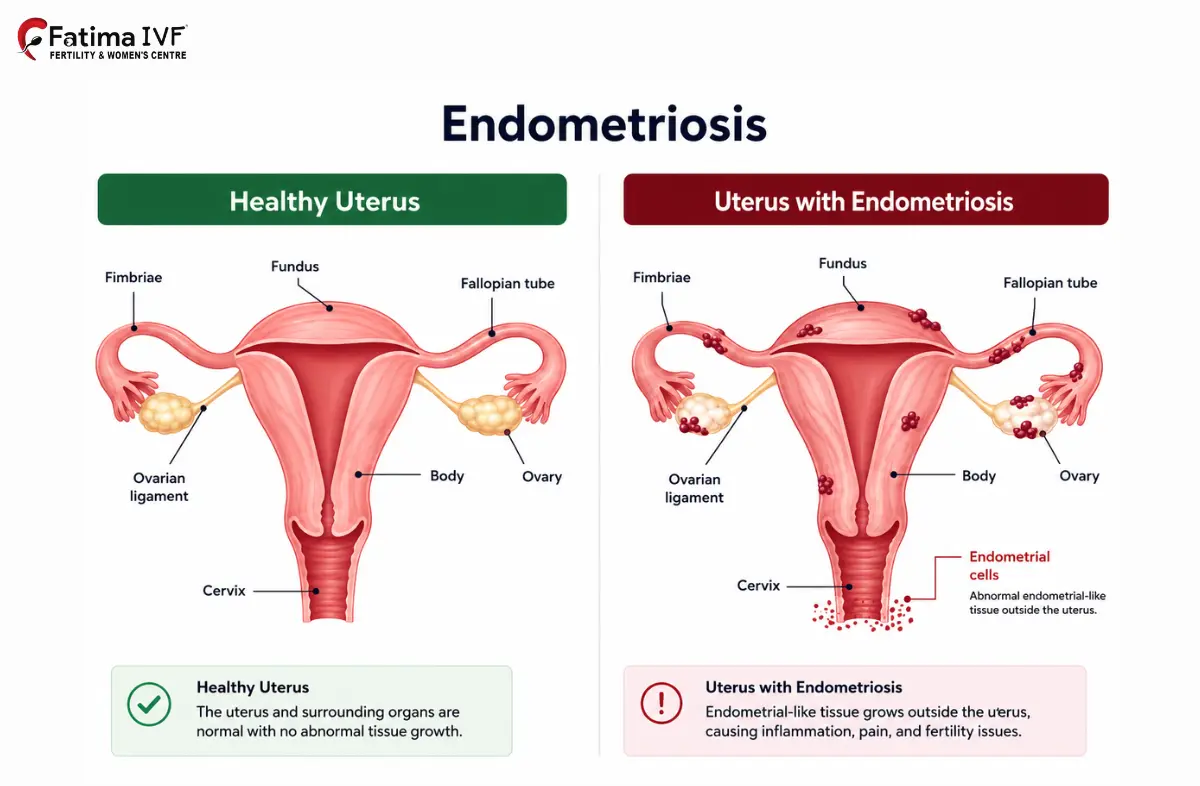
Endometriosis occurs when tissue similar to the uterine lining grows outside the uterus, often on the ovaries or fallopian tubes. This tissue can cause inflammation and scarring, which sometimes makes it harder for an egg and sperm to meet naturally. Common signs include painful periods, pain during intimacy, or ongoing pelvic discomfort, though some women have no symptoms at all. Depending on how severe it is, treatment can range from medication to minor surgery to assisted techniques like IUI or IVF. Our team tailors the approach based on exactly how endometriosis is affecting your fertility.
The fallopian tubes carry the egg from the ovary to the uterus, so any blockage can prevent natural conception. This can happen due to past pelvic infections, previous surgery, or a condition like endometriosis. A simple scan can usually show whether one or both tubes are open or blocked. In many cases, we can still help you conceive using IUI or IVF, which allow us to work around a blocked tube. This cause is easy to confirm and, once known, gives us a clear direction for treatment.
Fibroids are non-cancerous growths in or around the uterus, and depending on their size and position, they can affect how an embryo implants. Other uterine issues, like polyps or an unusual uterine shape, can have a similar effect. Many women with fibroids have no trouble conceiving at all, so we only recommend treatment when the fibroid is likely to be the actual cause. When needed, a minor procedure can often remove the fibroid and restore a healthy uterine lining. We always explain the size and location clearly before suggesting any next step.
As a woman gets older, the number and quality of eggs naturally decline, and this becomes more noticeable after the mid-30s. This is a normal biological process, not something to feel discouraged about, and many women in their late 30s and early 40s do conceive with the right support. Blood tests can estimate your current egg reserve, which helps us set realistic expectations together. Depending on the results, we may suggest moving a little faster to options like IUI or IVF. Acting sooner rather than later simply gives us more choices to work with.
Hormones like FSH, LH, prolactin, and thyroid hormones all play a part in regular ovulation and a healthy cycle. When any of these are too high or too low, periods can become irregular, or ovulation may stop altogether. A simple blood test done on specific days of your cycle can reveal these imbalances clearly. Many hormonal issues are corrected with medication, sometimes alongside small lifestyle adjustments. Once hormone levels are balanced, the body's natural fertility often improves noticeably.
Once we understand the cause, we walk you through the treatment options that suit your situation best. We always start with the simplest, least invasive option that makes sense for your case before considering more advanced steps.
Ovulation-inducing medicines help the ovaries release an egg on a more predictable schedule. These are often the first step for women with irregular ovulation or PCOS, since they are simple to take and closely monitored through scans. Most women respond within a few cycles, and we track your progress with ultrasounds to see how your ovaries are responding. If needed, the dosage is adjusted to get the best possible response. For many women, this alone is enough to achieve a natural pregnancy.
IUI involves placing specially prepared sperm directly into the uterus around the time of ovulation, giving sperm a shorter distance to travel. It is a straightforward, low-discomfort procedure often paired with ovulation medicine to improve the chances of success. IUI works well for mild male-factor issues, unexplained infertility, or when ovulation timing needs a little extra help. The procedure itself takes just a few minutes and does not require any recovery time. We usually recommend a few cycles of IUI before considering a more advanced option.
IVF involves collecting eggs from the ovaries and combining them with sperm in a lab, then transferring a resulting embryo back into the uterus. It is recommended for blocked tubes, more severe endometriosis, lower egg reserve, or when simpler treatments have not worked. The process includes several steps, from ovarian stimulation to egg collection to embryo transfer, and we guide you through each one closely. Advances in lab techniques have made IVF more effective and comfortable than it was even a few years ago. Every IVF cycle at Fatima Fertility is monitored personally by our team from start to finish.
ICSI is a specialized technique used alongside IVF, where a single healthy sperm is injected directly into an egg to support fertilization. It is particularly useful when there are sperm-related challenges or when previous IVF attempts saw poor fertilization. The rest of the IVF process, from embryo development to transfer, continues in the same way. ICSI has helped many couples overcome fertilization hurdles that would otherwise be difficult to manage. Our embryology lab performs this procedure with strict quality checks at every stage.
Minor surgery is sometimes recommended to remove fibroids, treat endometriosis, or open a blocked fallopian tube. Most of these procedures are done with minimally invasive techniques, meaning smaller cuts and a quicker recovery. Surgery is not always the first choice; we only suggest it when it clearly improves your chances of a natural pregnancy or makes future treatment more effective. We discuss the expected recovery time and next steps in detail before any procedure. Many women are able to try for pregnancy again within a few months of a successful surgery.
For women with very low egg reserve or certain genetic concerns, using donor eggs can be a meaningful path to pregnancy. Donor eggs are carefully matched and screened before use, and the rest of the process follows a standard IVF cycle. This option is discussed only when it genuinely fits your situation, and we take the time to answer every question you may have about it. Other assisted techniques, like frozen embryo transfer, may also be part of your plan depending on your history. Our goal is always to present every realistic option so you can make an informed, comfortable choice.
Treatment works best when it is matched directly to the cause behind it, which is why our female infertility treatment plans are never generic. Here is how we typically approach some of the most common causes.
For ovulation problems, we usually start with medicines that encourage the ovaries to release an egg on schedule. We track your response through ultrasound scans to time intercourse or IUI accurately. If medicine alone does not work after a few cycles, we may adjust the dosage or combine it with another approach. Lifestyle factors like weight and stress are also reviewed, since they can influence ovulation directly. Most women with straightforward ovulation issues respond well within a short treatment window.
Treating PCOS-related infertility usually combines a few approaches at once, including:
We adjust this combination based on how your body responds over the first few cycles. Many women with PCOS go on to conceive once ovulation becomes more regular.
When endometriosis is the main cause, treatment depends on how much it is affecting the ovaries or tubes. Mild cases often respond to ovulation medicine combined with IUI, while more advanced cases may need surgery to remove the affected tissue first. In some situations, moving directly to IVF gives the best chance, since it can bypass the areas affected by endometriosis. We explain exactly why a certain path is recommended, based on your scan results and history. The right choice always depends on your specific case rather than a standard routine.
If both tubes are blocked, IVF is usually the most direct and reliable path, since it does not depend on the tubes being open. If only one tube is affected, natural conception or IUI may still be possible depending on the other tube's condition. In select cases, a minor surgical procedure can reopen a blocked tube successfully. We review your scan results carefully to recommend the option most likely to work for you. This clarity helps avoid unnecessary delays in starting the right treatment.
For age-related infertility, timing matters more than with other causes, so we usually recommend moving a little faster through the treatment steps. This often means starting with IUI for a shorter period before considering IVF, especially if egg reserve tests show it is the better path. We also discuss options like egg freezing or donor eggs when relevant, always as an open conversation rather than a pressured decision. Every plan is built around your comfort level and personal goals. Age is one factor among several, and many women in this group do go on to have successful pregnancies.
Knowing what to expect can make the entire journey feel far less overwhelming, and a clear, step-by-step female infertility treatment process is exactly what we aim to offer every patient. Here is what the process generally looks like at Fatima Fertility.
Your first visit is mainly about listening and understanding your story, including your cycle history, past pregnancies, and any previous treatments. We ask questions in plain language and encourage you to ask just as many in return. This conversation helps us decide which tests will give us the most useful information. There is no pressure to decide on a treatment plan during this first visit. Our goal is simply to build a clear, honest picture together.
Based on your consultation, we arrange the specific tests needed, which may include blood work, ultrasounds, or a tube-check scan. These tests are scheduled around your natural cycle for the most accurate results. Once results come in, we review them with you in a follow-up visit and explain what each one means. This step often brings a lot of clarity, even before any treatment begins. We make sure you fully understand your results before moving to the next stage.
With your test results and history in hand, we discuss the treatment options that fit your specific cause and comfort level. We explain the expected process, timeline, and what each option generally involves, so there are no surprises later. You are always part of this decision, and we welcome questions about alternatives at every stage. Some women prefer to start with the simplest option first, while others prefer to move faster, and both approaches are respected. This step is really a shared decision between you and our team.
Once treatment begins, regular monitoring through scans and blood tests helps us track your progress closely. This allows us to make small adjustments along the way rather than waiting until the end of a cycle to notice an issue. We stay in close contact with you throughout, so you always know what stage you are at. After treatment, follow-up visits confirm results and outline the next step, whether that is a pregnancy confirmation or planning the following cycle. This ongoing support continues for as long as you need it.
Every woman wants to know her chances, and we believe in sharing honest, realistic numbers rather than vague promises.
Several factors influence how successful treatment is likely to be, including age, the underlying cause of infertility, and how the body responds to earlier treatment steps. Overall health, weight, and lifestyle habits also play a meaningful role. The specific treatment chosen, such as IUI versus IVF, naturally comes with different success expectations. We discuss your personal factors openly, rather than quoting a single generic number. This honest approach helps you set realistic expectations from the very beginning.
IVF success rates are generally highest for women under 35 and gradually decline with age, mainly due to natural changes in egg quality. Women in their late 30s and early 40s can still achieve pregnancy through IVF, though it may take a bit more patience or additional cycles. We share expected success ranges based on your specific age group and test results during your consultation. This helps you plan both emotionally and practically for the journey ahead. Every case is reviewed individually rather than compared to a general average alone.
Some women conceive in their very first treatment cycle, while others may need two or three cycles before success. This does not mean anything is wrong; fertility treatment often works gradually as we fine-tune the approach based on your body's response. We review each cycle carefully to understand what worked well and what could be adjusted next time. Being prepared for the possibility of more than one cycle can make the process feel less stressful. Our team stays with you through every cycle, adjusting the plan as needed.
We believe cost should never be a mystery, so we explain pricing clearly before any treatment begins.
A few factors typically affect the overall cost of treatment, such as:
We walk you through an estimated cost for your specific plan before starting, so there are no surprises later.
IUI is generally more affordable than IVF, since it involves fewer steps and less lab work. IVF costs more because it includes egg collection, lab fertilization, embryo culture, and transfer, along with closer monitoring throughout. Costs can also vary based on the medication protocol your body needs. We provide a clear, itemized estimate during your consultation so you know exactly what each step involves. This transparency helps you plan your finances alongside your treatment timeline.
Some insurance plans cover part of the diagnostic testing or specific treatments, so it is worth checking your policy details early on. Our team can help you understand what documentation might be needed for any insurance claims. We also discuss flexible payment options where available, so cost does not become a barrier to starting treatment. Being upfront about finances from the start helps you focus on the treatment itself. We are always happy to answer specific cost questions during your visit.
Alongside medical treatment, small daily habits can genuinely support your fertility journey.
Both being underweight and being significantly overweight can affect ovulation and hormone balance. Even a small, gradual change toward a healthy weight range can help restore more regular cycles for many women. We suggest realistic, sustainable changes rather than quick fixes, since steady progress tends to work better for fertility. This is discussed as one part of your overall plan, never as pressure or blame. Our team can guide you toward simple, practical steps that fit your daily routine.
A balanced diet can support hormone health and overall reproductive function. Helpful habits include:
These small changes work best when they become part of a steady, everyday routine rather than a short-term effort.
Fertility treatment can bring its own emotional ups and downs, and stress itself can sometimes affect hormone balance. Simple practices like gentle yoga, walking, or a few minutes of quiet breathing each day can help you feel more grounded. Talking openly with your partner or a counsellor can also ease the emotional load. We encourage patients to be kind to themselves throughout the process, since this journey is rarely a straight line. Our team is always available to listen, not just to treat.
Smoking and heavy alcohol use can affect egg quality and overall reproductive health, so cutting back can genuinely improve your chances. Even reducing gradually, rather than stopping all at once, can make a positive difference over time. We discuss this as a supportive conversation, not a judgment, since we understand habits can be hard to change. Small, steady steps in this area often add up to a meaningful improvement in fertility outcomes. Our team is here to support you through these changes, however small the step.
Medical care has come a long way, and today, most causes behind the need for female infertility treatment can be identified and managed with the right care and patience. At Fatima Fertility, Dr. Fathimunissa and the team work closely with every patient to build a plan that fits her specific body, cause, and comfort level. Our centre is easy to reach for patients across Chennai, including those searching for a female infertility specialist in Chennai, an infertility treatment in Anna Nagar, or a fertility clinic for women in Chennai, with convenient appointment slots and a welcoming, accessible clinic environment. If you are ready to take the next step, we would be glad to walk this journey with you, one clear step at a time.
Meet our experienced team of anaesthesiologists dedicated to your safety and comfort
The first step is usually a detailed consultation followed by basic tests like hormone blood work and an ultrasound. This helps identify the likely cause before recommending any treatment.
This varies by cause and treatment type. Some women conceive within one or two cycles of medication or IUI, while others may need a few cycles of IVF. Your doctor will give you a realistic timeline based on your test results.
No, IVF is just one of several options. Depending on the cause, treatment may start with ovulation medicine, move to IUI, or include minor surgery, with IVF recommended only when it is the most suitable path.
Yes, PCOS-related infertility is commonly treated with a combination of ovulation medicine, lifestyle changes, and monitoring. Many women with PCOS go on to conceive once ovulation becomes more regular.
Age can influence egg quality and quantity, which affects treatment success rates, especially with IVF. However, many women in their late 30s and early 40s still conceive successfully with the right approach.
Cost depends on the type of treatment, number of cycles, and any additional tests needed. A clear, itemized estimate is provided during your consultation before treatment begins.
Take the first step toward parenthood. Book an appointment with our expert team to receive expert guidance, emotional support, and advanced fertility solutions designed just for you.