Fatima IVF Fertility & Women’s Centre, led by Dr. Fathimunissa, is a trusted infertility centre in Chennai, offering evidence-based diagnosis and treatment for couples facing difficulty conceiving. Our team combines advanced reproductive technology with personalized care, guiding each patient from the first consultation through to a clear, honest treatment plan built around their specific fertility needs.
Why Choose Our Infertility Centre in Chennai?
Choosing the right infertility centre in Chennai can shape the entire course of your fertility journey. At Fatima IVF Fertility & Women’s Centre, couples receive a combination of clinical expertise, modern technology, and steady emotional support — three factors that together improve both comfort and outcomes during treatment.
Personalized Fertility Care with Dr. Fathimunnissa
Dr. Fathimunnissa
At Fatima IVF, fertility care is guided by Dr. Fathimunnissa, a highly experienced fertility specialist dedicated to helping couples navigate their journey to parenthood with confidence and clarity. With more than two decades of clinical experience, she is known for delivering personalized fertility solutions tailored to each patient’s unique needs.
- Qualifications: MBBS (Kilpauk Medical College), MS – Obstetrics & Gynaecology (Sri Ramachandra Medical College), Fellowship in Fertility Medicine, Fellowship in Laparoscopy, Degree in Fertility Medicine (Germany)
- Specialties: Fertility & IVF, Reproductive Medicine, Obstetrics, Gynaecology, Laparoscopic Procedures
- Experience: 20+ Years
- Consultation Locations: Anna Nagar & Triplicane, Chennai

Her expertise covers a wide range of reproductive health services, including IVF, ICSI, IUI, fertility assessments, laparoscopic procedures, and comprehensive fertility management for both men and women. She has successfully supported numerous individuals and couples in overcoming fertility challenges and achieving their family-building goals.
Dr. Fathimunnissa believes in a patient-first approach, focusing on detailed evaluations, transparent guidance, and treatment plans designed around individual circumstances. Her compassionate communication style helps patients feel informed, comfortable, and supported throughout their fertility journey.
In addition to her role at Fatima IVF, she is associated with leading healthcare institutions, including MGM Hospitals and Mehta Hospitals, further reflecting her commitment to excellence in reproductive medicine.
Experienced Fertility Specialists
Our fertility team brings years of hands-on experience diagnosing and treating both female and male infertility. Rather than following a one-size-fits-all protocol, our specialists review each case individually — hormone levels, scan findings, past treatment history — before recommending a path forward.
Advanced IVF Laboratory & Technology
Our IVF lab is equipped with time-lapse embryo monitoring and controlled culture conditions that support healthy embryo development. Maintaining a stable lab environment is one of the most important, and often overlooked, factors in treatment success.
Personalized Fertility Treatment Plans
No two fertility journeys look the same, which is why every patient at our centre receives a treatment plan tailored to her specific diagnosis, age, and medical history — rather than a standard package applied to everyone.
Compassionate Care Throughout Your Journey
Fertility treatment can be emotionally demanding. Our team stays in close contact with patients at every stage, answering questions honestly and adjusting plans when needed, so couples never feel like just another case number.
Understanding Infertility
Infertility is more common than most couples realize, and understanding it clearly is the first step toward finding the right treatment.
What is Infertility?
Infertility is generally defined as the inability to conceive after one year of regular, unprotected intercourse (or six months if the woman is over 35). It can stem from either partner, or a combination of factors, and does not mean parenthood is out of reach.
Common Causes of Infertility in Women
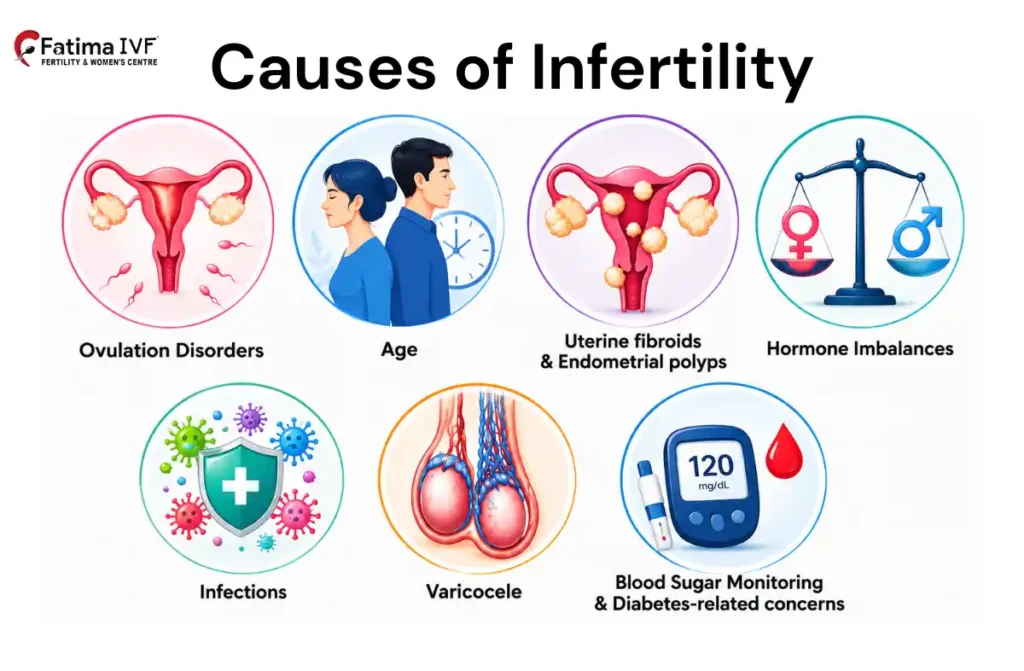
Common causes include ovulation disorders like PCOS, blocked or damaged fallopian tubes, endometriosis, uterine fibroids, and age-related decline in egg quality. Hormonal imbalances also play a significant role in many cases we see.
Common Causes of Male Infertility
Male infertility is often linked to low sperm count, poor sperm motility, structural issues like varicocele, or hormonal imbalances. In many cases, a simple semen analysis is enough to identify the underlying cause.
When Should You Visit an Infertility Specialist?
If you’ve been trying to conceive for over a year without success — or six months if you’re above 35 — it’s worth speaking to an infertility centre in Chennai early rather than waiting. Earlier evaluation often means more treatment options and better outcomes.
Fertility Evaluation & Diagnosis
A precise diagnosis is the foundation of effective fertility treatment, and our evaluation process is designed to be thorough but not overwhelming.
Female Fertility Assessment
We assess ovarian reserve, hormone levels, and uterine health through a combination of blood tests and imaging, giving us a clear picture of what may be affecting conception.
Male Fertility Testing
Semen analysis remains the starting point for male evaluation, checking sperm count, motility, and morphology. Further hormonal or genetic testing is done only when needed.
Hormonal and Ultrasound Evaluation
Hormonal panels combined with pelvic ultrasound help us detect issues like PCOS, ovarian cysts, or thin uterine lining that can affect implantation.
Advanced Diagnostic Procedures
For more complex cases, procedures like hysteroscopy or laparoscopy may be recommended to directly examine the uterus and pelvic organs when standard tests don’t give a complete answer.
Infertility Treatments Available at Our Chennai Centre
As a comprehensive infertility treatment centre in Chennai, we offer a full range of options — from simple ovulation induction to advanced IVF and ICSI — so couples can start with the least invasive approach appropriate for their diagnosis.
Ovulation Induction
For women with irregular ovulation, medication is used to stimulate egg release, often combined with timed intercourse or IUI to improve conception chances.
Intrauterine Insemination (IUI)
IUI places specially prepared sperm directly into the uterus around the time of ovulation, a straightforward first step for many couples with mild fertility challenges.
In Vitro Fertilization (IVF)
IVF involves stimulating the ovaries, retrieving eggs, fertilizing them with sperm in the lab, and transferring the resulting embryo into the uterus. It remains one of the most effective treatments available today.
Intracytoplasmic Sperm Injection (ICSI)
ICSI involves injecting a single sperm directly into an egg, and is particularly useful when sperm count or motility is low.
Blastocyst Transfer
Allowing embryos to develop to the blastocyst stage (day 5-6) before transfer helps our team select the strongest embryo, often improving implantation rates.
Fertility Preservation (Egg & Embryo Freezing)
For patients who wish to delay pregnancy for medical or personal reasons, we offer egg and embryo freezing using vitrification, a fast-freezing technique that protects egg quality.
Donor Egg & Donor Sperm Programs
For couples who need donor gametes, we run a carefully screened donor program with full counseling support throughout the process.
Female Infertility Treatment
Female fertility issues vary widely, so treatment is always matched to the specific diagnosis rather than applied generically.
- PCOS & Ovulation Disorders PCOS is managed through a combination of lifestyle guidance, medication, and, when needed, assisted reproduction to help regulate ovulation.
- Endometriosis Treatment Depending on severity, endometriosis may be treated with medication, laparoscopic surgery, or IVF when natural conception is unlikely.
- Tubal Factor Infertility When fallopian tubes are blocked or damaged, IVF often bypasses the issue entirely by fertilizing eggs outside the body.
- Uterine Fibroids & Polyps Fibroids and polyps affecting the uterine cavity can often be removed through minimally invasive hysteroscopic surgery, improving chances of implantation.
- Recurrent Pregnancy Loss Management For couples who’ve experienced repeated miscarriage, we investigate genetic, hormonal, and structural causes to build a more targeted treatment plan.
Male Infertility Treatment
Male-factor infertility is involved in roughly half of all cases, and treatment is just as individualized as it is for women.
- Low Sperm Count Low sperm count may respond to medication, lifestyle changes, or assisted techniques like IUI or ICSI depending on severity.
- Poor Sperm Motility When sperm movement is impaired, lab techniques can select the healthiest, most motile sperm for use in IUI or IVF/ICSI.
- Varicocele Varicocele, an enlargement of veins in the scrotum, can sometimes be corrected surgically to improve sperm parameters over time.
- Surgical Sperm Retrieval For men with no sperm in their semen, surgical retrieval techniques can often collect sperm directly from the testes for use in ICSI.
Advanced Fertility Technologies
We invest in technology that gives our embryology team more information and more control over each stage of treatment.
- Time-Lapse Embryo Monitoring: Continuous imaging tracks embryo development without disturbing the culture environment, helping embryologists select the best embryo for transfer.
- Embryo Freezing: Vitrification allows extra embryos to be frozen safely for future use, giving couples more chances from a single stimulation cycle.
- Genetic Screening (PGT): Preimplantation genetic testing can screen embryos for chromosomal abnormalities before transfer, which is particularly useful for older patients or those with recurrent loss.
- Laser-Assisted Hatching: A small opening is made in the embryo’s outer shell to help it implant more easily, used selectively based on embryo quality and patient history.
Success Rates at Our Infertility Centre in Chennai
As a high success rate infertility centre in Chennai, we believe in being transparent about outcomes rather than making broad promises, since success always depends on individual factors.
Factors That Influence Success Rates
Age, ovarian reserve, sperm quality, and the underlying cause of infertility all influence the likelihood of success — which is why we discuss realistic expectations with every patient upfront.
Personalized Treatment Improves Outcomes
Our data shows that tailoring stimulation protocols and lab techniques to each patient’s profile, rather than using a fixed protocol for everyone, consistently produces better outcomes.
Meet Our Fertility Specialist
Expertise in Reproductive Medicine
Dr. Fathimunissa, our lead fertility specialist, brings extensive experience in reproductive endocrinology and infertility treatment, having guided hundreds of couples through successful IVF and ICSI cycles.
Patient-Centered Approach
Dr. Fathimunissa , believes every treatment plan should reflect the patient in front of them, not a textbook case — spending time explaining options clearly so couples can make informed decisions.
What to Expect During Your First Consultation?
Medical History Review
Your first visit begins with a detailed discussion of your medical history, previous pregnancies, and any prior fertility treatment.
Fertility Tests
Based on your history, we’ll recommend targeted tests rather than a blanket panel, so you’re not paying for evaluations you don’t need.
Customized Treatment Planning
Once results are in, we sit down with you to explain findings in plain language and map out a treatment plan together.
Cost of Infertility Treatment in Chennai
Factors Affecting Treatment Cost
Cost varies based on the type of treatment, medication dosage, number of cycles needed, and any additional procedures like PGT or donor programs.
Transparent Pricing & Treatment Plans
We provide a clear cost breakdown before starting treatment, so couples can plan financially without hidden surprises along the way.
Why Couples Trust Our Infertility Centre
Modern Infrastructure
Our facility is equipped with a modern IVF lab, diagnostic imaging, and comfortable patient spaces designed to reduce the stress often associated with fertility treatment.
Ethical Fertility Care
We recommend treatment based on medical necessity, not upselling — patients are never pushed toward advanced procedures unless clinically appropriate.
High Patient Satisfaction
Many of our patients come through word-of-mouth referrals from couples we’ve previously treated, which we consider our strongest measure of trust.
Convenient Chennai Locations
Our centre is accessible from across Chennai, making regular monitoring visits — an essential part of fertility treatment — easier to manage.
Conclusion
If you and your partner are facing challenges conceiving, know that support and effective treatment are available close to home. As a dedicated infertility centre in Chennai, Fatima IVF Fertility & Women’s Centre is committed to walking with you through every step, from diagnosis to delivery, with honesty and genuine expertise guiding every decision.
This guide is written for you. Whether you are just starting to think about visiting an infertility centre in Chennai or you have already tried treatment somewhere else and it did not work, we want to give you clear and honest information so you can take the next step with confidence.