

Safety Rate
Choosing between normal and cesarean deliveries depends on your health, your baby’s position, and how your labor progresses. At Fatima IVF Fertility & Women’s Centre in Chennai, Dr. Fathimunissa guides every mother through both Normal & Cesarean Deliveries options so she understands the safest path to a healthy birth, well before her due date arrives.
Over the years, I have delivered babies through both routes, and I have learned that no two births are the same. Some mothers walk into labor and everything progresses naturally. Others need a cesarean because of the baby’s position, a slow labor, or a health condition that needs closer control. My goal in this article is to walk you through both delivery methods in plain language, so you feel prepared and confident, not anxious, about the day your baby arrives.
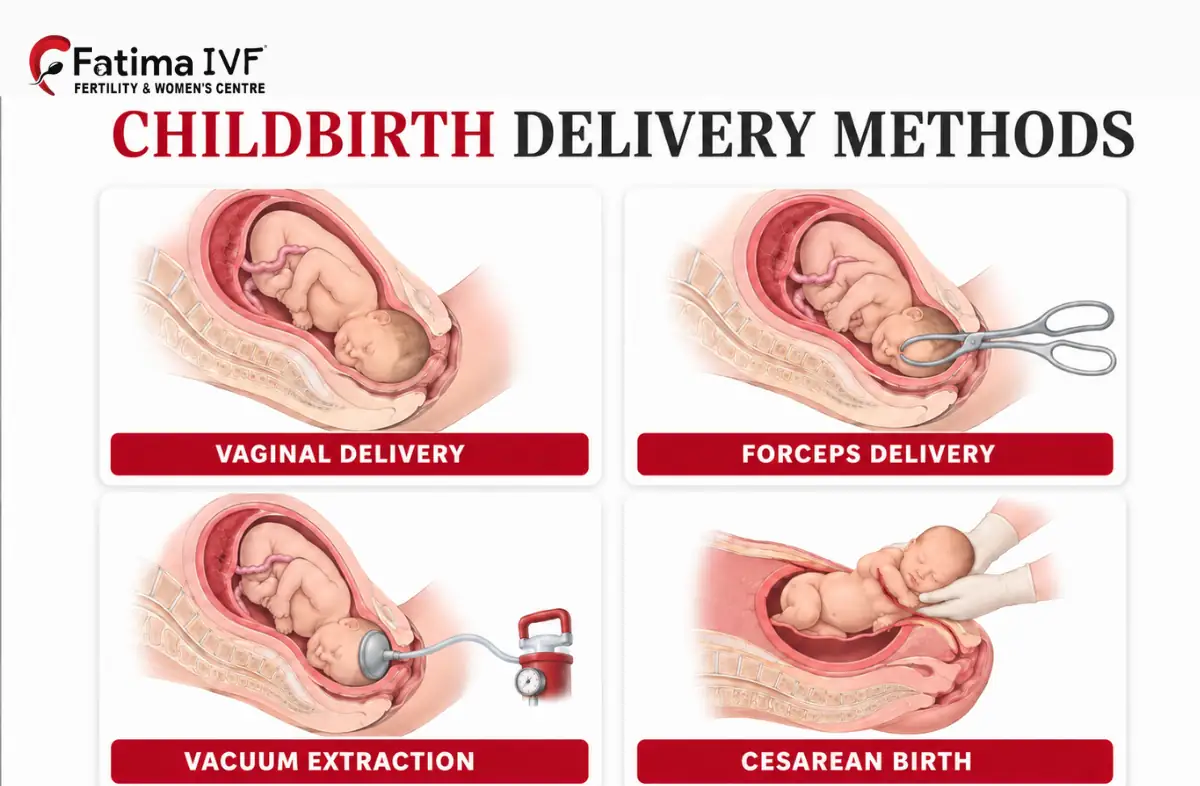
A normal delivery, also called a vaginal delivery, happens when a baby is born through the birth canal without surgery. Labor begins on its own or is gently induced, and the mother pushes the baby out over several hours. Most healthy pregnancies with no major complications are good candidates for this natural process.
Not every vaginal birth looks the same. A spontaneous vaginal delivery happens when labor starts and progresses on its own. An assisted vaginal delivery uses forceps or a vacuum device when the baby needs a little extra help in the final stage of pushing. Some mothers at our centre also choose water-assisted labor for the early stages, which can ease pain naturally before delivery.
Many of my patients ask why doctors encourage vaginal birth when it is medically safe to do so. Here is what I usually explain:
Vaginal birth is generally safe, but like any medical process, it carries some risks. These include tearing of the vaginal tissue, prolonged labor, or the need to switch to a cesarean if the baby shows signs of distress. I monitor every mother closely with continuous fetal heart tracking so we can respond quickly if anything changes.
Most first-time mothers with a healthy, head-down baby and no major pregnancy complications can plan for a vaginal birth. When I counsel patients weighing Normal & Cesarean Deliveries as their due date nears, I look closely at the baby's position, the mother's pelvic shape, and any prior surgical history before recommending a path forward.
Recovery after vaginal birth is usually quicker. Most mothers can walk within hours of delivery and go home in one to two days. Mild soreness, especially if stitches were needed, typically eases within one to two weeks with simple pain relief and rest.
A cesarean delivery is a surgical birth where the baby is delivered through an incision in the mother's abdomen and uterus. It is performed under anesthesia and usually takes 45 minutes to an hour. Some are planned in advance, while others are decided during labor if complications arise.
There are two broad categories worth understanding:
I recommend a cesarean when continuing labor could put the mother or baby at risk. Common reasons include a baby in the breech position, a placenta covering the cervix, twin or multiple pregnancies with complications, or a labor that has stalled despite hours of strong contractions. Whenever I counsel a family on Normal & Cesarean Deliveries at this stage, I walk through the specific finding that is driving the recommendation, so the choice never feels sudden or unexplained.
A cesarean can be scheduled in advance, which helps with planning around family support and hospital arrangements. It also allows immediate delivery when a baby is in distress, and it avoids prolonged labor in cases where a vaginal birth carries higher risk for mother or baby.
As with any surgery, a cesarean carries risks such as infection, longer healing time, and a slightly higher chance of complications in future pregnancies. I discuss these openly with every patient so the decision, when there is a choice, is made with full understanding rather than fear.
Recovery after a cesarean generally takes longer, with a hospital stay of three to four days and a full recovery period of four to six weeks. I encourage gentle movement early on, along with proper wound care, to help the body heal well and reduce the risk of complications.
The clearest difference comes down to how the baby is born: through the birth canal in a vaginal delivery, or through a surgical incision in a cesarean. When patients compare Normal & Cesarean Deliveries side by side, the decision usually comes down to the mother's health, the baby's position, and how labor is progressing on the day itself.
Vaginal birth recovery is generally measured in days, while cesarean recovery is measured in weeks. Most mothers who deliver vaginally are back to light routines within a week, while cesarean mothers need to avoid heavy lifting and strenuous activity for closer to six weeks.
Labor pain during a vaginal birth is real but manageable, especially with epidural support if the mother wants it. A cesarean involves surgical pain afterward, usually managed with medication for the first several days, tapering off as the incision heals.
Both methods are safe when guided by careful monitoring. Vaginal birth carries a small risk of tearing or prolonged labor, while cesarean surgery carries standard surgical risks like infection or bleeding. I choose the safer option for each individual mother rather than applying a one-size-fits-all rule.
Vaginal deliveries are generally less expensive than cesarean deliveries, mainly because they involve a shorter hospital stay and no operating room costs. That said, cost should never be the only factor — the medical safety of mother and baby always comes first.
A vaginal birth does not usually limit future delivery options. A cesarean, on the other hand, may mean future pregnancies need closer monitoring, and in some cases a repeat cesarean is recommended, depending on the type of incision and healing.
Conditions such as high blood pressure, diabetes, or a history of uterine surgery can influence whether a vaginal birth is advisable. I review each mother's full medical history well before the due date so there are no last-minute surprises.
A baby in the head-down position is the ideal setup for a normal delivery. A breech or transverse position, or signs of fetal distress on monitoring, often shifts the plan toward a cesarean for the baby's safety.
Conditions like placenta previa, umbilical cord issues, or slow fetal growth can make a cesarean the safer choice. I explain each finding clearly with my patients so they understand exactly why a particular path is being recommended.
Sometimes labor that started normally needs to shift to a cesarean midway, if the baby's heart rate drops or labor stalls for too long. Our labor ward is equipped to move quickly into an operating room when minutes matter.
Attending antenatal classes, practicing breathing techniques, and staying active during pregnancy can all support a smoother vaginal birth. I also encourage mothers to discuss pain relief preferences, like an epidural, well ahead of labor day.
If a cesarean is scheduled, I go over pre-surgery instructions such as fasting time, medication adjustments, and what to expect in the operating room. Knowing the steps in advance helps most mothers feel far calmer on the day itself.
A few essentials make hospital stays smoother, whichever delivery path you take:
Mothers across the city trust our team for Normal & Cesarean Deliveries in Chennai, supported by a labor ward equipped for both planned and emergency births.
For families closer to the city centre, we offer complete Normal & Cesarean Deliveries Treatment in Annanagar, including antenatal check-ups, labor monitoring, and post-delivery care under one roof.
Patients from the southern parts of the city often reach us for Normal & Cesarean Deliveries in Triplicane, with the same personal attention and round-the-clock support available for every mother on our care team.
Every birth is different, and there is no single right answer between a vaginal birth and a surgical one. What matters most is that the decision on Normal & Cesarean Deliveries is made with full information, careful monitoring, and a doctor who takes the time to explain the "why" behind every recommendation. At Fatima IVF Fertility & Women's Centre, my team and I are here to walk that journey with you, from your first antenatal visit to the day you hold your baby.
Meet our experienced team of anaesthesiologists dedicated to your safety and comfort
Your doctor decides based on your health, your baby’s position, and how labor is progressing. Dr. Fathimunissa reviews this with every patient well before the due date, and again during labor if anything changes.
Not necessarily. Vaginal birth is generally lower-risk when there are no complications, but a cesarean can be the safer option in specific situations, such as a breech baby or fetal distress.
Vaginal birth recovery usually takes about one to two weeks, while cesarean recovery takes closer to four to six weeks, since it involves healing from surgery.
It depends on the type of incision from the earlier surgery and how the current pregnancy is progressing. Dr. Fathimunissa evaluates this case by case during antenatal visits.
Yes. Our labor ward is equipped for both planned and emergency Normal & Cesarean Deliveries, with round-the-clock monitoring for mother and baby.
Take the first step toward parenthood. Book an appointment with our expert team to receive expert guidance, emotional support, and advanced fertility solutions designed just for you.