Let me begin with an honest statement. If you have landed on this page, chances are high that you have been hoping for a pregnancy that has not yet arrived, and you are now seeking information about the treatment of infertility. Each month brings new hope followed by disappointment. Seeing others announce their pregnancies while you wait for your turn can feel deeply painful. Here is what you need to hear today: Nothing is wrong with you. And you are walking this road alongside millions of others.
Medical data shows that roughly one out of every eight couples faces difficulty conceiving. That is not a small number. That is a vast community of people sharing your exact struggle. The encouraging news is that medical science has made remarkable progress in the treatment of infertility, helping individuals and couples build their families through options ranging from simple medication to advanced reproductive technology.
What is Infertility?
Infertility is a medical condition where a couple is unable to achieve pregnancy despite trying regularly without contraception. Understanding the treatment of infertility begins with knowing these timelines:
- Under 35 years: No pregnancy after 12 months of trying
- 35 years and above: No pregnancy after 6 months of trying
It is important to understand that infertility does not mean pregnancy will never happen. It simply means that conception is taking longer than expected and medical support may be needed . The treatment of infertility is rarely focused on a single problem. Successful pregnancy depends on many steps happening at the right time: healthy sperm, regular ovulation, open fallopian tubes, and a uterus ready for implantation. If any one of these steps is affected, conception can become difficult.
Infertility Causes and Treatment
Most couples assume that when basic fertility tests come back “normal,” nothing is wrong. That assumption is dangerous. Standard testing checks three things: ovulation, sperm count, and tube patency. But here is what those tests do not see. Understanding infertility causes and treatment requires looking into the shadows where standard medicine rarely shines a light.
1. Silent Endometriosis
Standard ultrasounds miss up to 80% of endometriosis cases. Tiny implants create chronic inflammation that poisons the pelvic environment. Eggs fail to implant not because anything is blocked, but because the chemical soup is toxic.
The treatment: Laparoscopic excision surgery. Pregnancy rates improve by 40-60% after expert excision.
2. Chronic Endometritis
This is a low-grade bacterial infection of the uterine lining. It causes no symptoms. No pain. No fever. But it prevents embryos from attaching. Standard fertility testing never looks for it. This is why a complete approach to infertility causes and treatment must include an endometrial biopsy.
The treatment: An endometrial biopsy followed by 14 days of antibiotics (doxycycline). Success rates exceed 70%.
3. Thyroid Autoimmunity
Your thyroid can function perfectly while your immune system silently attacks thyroid tissue. Those antibodies also attack placental tissue. Most doctors never order thyroid antibody tests unless you ask.
The treatment: Low-dose levothyroxine to lower TSH below 2.5, plus selenium. Pregnancy loss rates drop by nearly 60%.
4. Inherited Thrombophilias
Blood clotting disorders like Factor V Leiden create microscopic clots in uterine arteries. The embryo starves before it can grow. When exploring infertility causes and treatment, these clotting disorders are often the missing piece.
The treatment: Low-dose aspirin and therapeutic heparin during early pregnancy. Live birth rates triple.
Female Infertility Treatment
Most resources separate “female treatments” and “male treatments” as if they exist in different universes. That is a mistake. A couple is a single reproductive unit. A successful approach to female infertility treatment requires treating both partners as one team.
The Female Reproductive System: Six Failure Points
Failure Point 1: Ovulation Disorders
The ovaries do not release an egg regularly. This accounts for roughly 25% of female factor cases.
- PCOS: Letrozole is preferred over Clomid. Success rates reach 40-50% per cycle.
- Hypothalamic amenorrhea: Pulsatile GnRH therapy or injectable gonadotropins. Lifestyle changes (increasing body fat, reducing exercise) are essential.
- Primary ovarian insufficiency: Donor eggs offer the highest success rates.
Failure Point 2: Tubal Factor
The fallopian tubes are blocked or damaged. Sperm cannot reach the egg, or the fertilized egg cannot reach the uterus.
- Hydrosalpinx: The affected tube should be removed before IVF. Success rates double after treatment.
- Severe tubal damage: IVF bypasses the tubes entirely.
Failure Point 3: Uterine Factor
The uterus cannot support implantation or pregnancy growth.
- Polyps, fibroids, septum, adhesions: Hysteroscopic resection. Pregnancy rates improve by 40-80%.
- Chronic endometritis: 14 days of antibiotics. Success exceeds 70%.
- Severe uterine factor: Gestational surrogacy is the only option.
Failure Point 4: Cervical Factor
Cervical mucus is hostile to sperm, or the cervical canal is scarred.
- Treatment: Intrauterine insemination (IUI) bypasses the cervix entirely.
When both partners have contributing factors, integrated female and male infertility treatment becomes even more critical.
Assisted Reproductive Technology
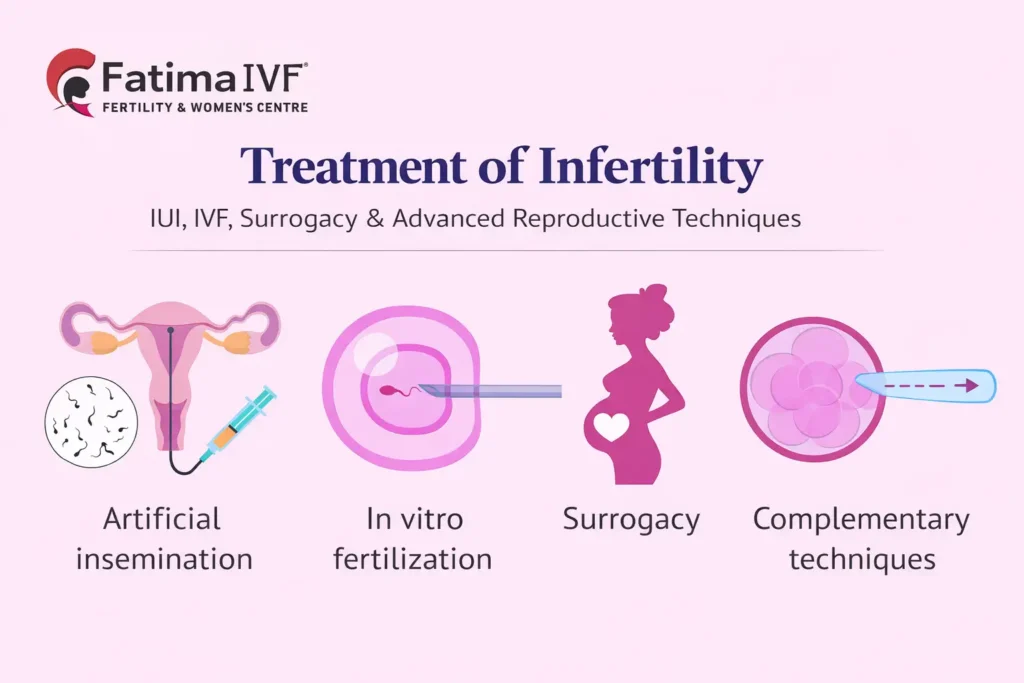
Assisted reproductive technology, commonly abbreviated as ART, refers to any medical procedure that involves handling eggs, sperm, or embryos outside the human body. These techniques have revolutionized fertility care and offer hope to millions of couples who cannot conceive through natural means. Understanding each type of assisted reproductive technology helps couples make informed decisions about their fertility journey. Below is a detailed explanation of each major ART procedure in paragraph form.
1. Intrauterine Insemination (IUI)
Intrauterine insemination, or IUI, is the simplest form of assisted reproductive technology. In this procedure, a doctor collects a sperm sample from the male partner or a donor. The sample is then “washed” in a laboratory to separate healthy, motile sperm from seminal fluid and debris. Using a thin, flexible catheter, the doctor places the washed sperm directly into the woman’s uterus, bypassing the cervix entirely. This procedure takes only five to ten minutes and causes minimal discomfort, often described as mild cramping.
2. In Vitro Fertilization (IVF)
In vitro fertilization, known worldwide as IVF, is the most famous and widely used form of assisted reproductive technology. The process begins with ovarian stimulation, where the woman takes hormone injections for eight to twelve days to encourage her ovaries to produce multiple mature eggs. When the eggs are ready, the doctor performs an egg retrieval procedure under light sedation. A thin needle is passed through the vaginal wall into each ovary, and the fluid containing the eggs is gently suctioned out. This takes about fifteen minutes. The retrieved eggs are then combined with sperm in a laboratory dish, and fertilization occurs naturally or with the help of ICSI.
3. Intracytoplasmic Sperm Injection (ICSI)
Intracytoplasmic sperm injection is a specialized form of IVF designed to overcome severe male factor infertility. The difference between standard IVF and ICSI lies in how the egg and sperm are combined. In standard IVF, thousands of sperm are placed in a dish with an egg, and one sperm naturally swims inside to fertilize it. In ICSI, an embryologist uses a microscopic glass needle to pick up a single, healthy-looking sperm and injects it directly into the center of a mature egg.
4. Preimplantation Genetic Testing (PGT)
Preimplantation genetic testing, or PGT, is an advanced technique used in conjunction with IVF to screen embryos for genetic abnormalities before transfer. On day five or six of embryo development, when the embryo has reached the blastocyst stage, an embryologist uses a laser to create a small opening in the outer shell of the embryo. A few cells are gently removed from the trophectoderm (the part that will become the placenta) and sent to a genetic laboratory for analysis. The remaining embryo is frozen while awaiting results.
5. Donor Egg or Donor Sperm
For some individuals and couples, the use of donor eggs or donor sperm is the most effective path to parenthood. Donor eggs are typically obtained from a healthy, young woman (usually under 30) who has undergone rigorous medical and genetic screening. The donor completes an IVF cycle, and her eggs are retrieved and fertilized with the intended father’s sperm (or donor sperm) to create embryos. One or two embryos are then transferred into the uterus of the intended mother or a gestational carrier.
Donor eggs are recommended for women with primary ovarian insufficiency (early menopause), women over 42 years of age whose own eggs have very low chances of success, women with poor egg quality due to chemotherapy or radiation, and those who have experienced multiple failed IVF cycles with their own eggs.
6. Gestational Carrier (Surrogacy)
A gestational carrier, often referred to as a surrogate, is a woman who carries a pregnancy for another individual or couple. The key distinction is that a gestational carrier has no genetic relationship to the baby. The embryo is created using the intended parents’ eggs and sperm (or donor gametes) through IVF and then transferred into the carrier’s uterus. The carrier gestates the pregnancy and delivers the baby, who is then handed over to the intended parents.
Whether you are considering IUI, IVF, ICSI, or surrogacy, modern assisted reproductive technology offers a path forward for nearly every type of infertility.
Best Infertility Treatment Options
Stop searching for “best infertility treatment options” in the abstract. Here is the best option for each specific diagnosis.
| Diagnosis | Best First-Line Treatment | Success Rate |
| PCOS | Letrozole + timed intercourse | 40-50% per cycle |
| Hypothalamic amenorrhea | Pulsatile GnRH or gonadotropins | 70-80% per cycle |
| Blocked tubes (severe) | IVF | 40-50% per transfer |
| Hydrosalpinx | Tube removal + IVF | 50-60% per transfer |
| Uterine polyp | Hysteroscopic polypectomy | 60-80% improvement |
| Asherman’s syndrome | Hysteroscopic adhesiolysis | 70-90% improvement |
| Mild male factor | IUI | 10-15% per cycle |
| Severe male factor | IVF + ICSI | 40-50% per transfer |
| Obstructive azoospermia | TESA + IVF/ICSI | 50-60% per transfer |
| Non-obstructive azoospermia | Micro-TESE + IVF/ICSI | 40-60% sperm found |
| Unexplained (under 35) | 3-4 IUI then IVF | 15-20% IUI, 45-50% IVF |
| Unexplained (over 38) | IVF directly | 25-35% per transfer |
| Endometriosis (I-II) | Excision or IVF | 40-50% per transfer |
| Endometriosis (III-IV) | IVF directly | 35-45% per transfer |
| Diminished reserve (under 38) | IVF + PGT-A | 25-35% per transfer |
| Diminished reserve (over 42) | Donor eggs | 50-70% per transfer |
Your Five-Step Action Plan
Step 1: Call a reproductive endocrinologist this week for an initial consultation.
Step 2: Bring your partner to that first appointment within two weeks.
Step 3: Complete basic fertility testing within one month.
Step 4: Review your diagnosis and treatment options within six weeks.
Step 5: Begin your first treatment cycle within two to three months.
Conclusion
Infertility feels overwhelming, but most cases respond to treatment. Modern options from medications to IVF have helped countless couples welcome babies. If you are struggling, do not lose hope. Consult a fertility specialist today.
If you are facing difficulty conceiving, consider visiting a trusted fertility clinic for guidance. At Fatima Fertility Center, experienced specialists provide personalized care and support at every step. Taking that first step toward consultation could bring you closer to your dream of parenthood.