
If you and your partner are trying to start a family and it isn’t happening as quickly as you hoped, talking to a fertility specialist in Anna Nagar can help. Dr. Fathimunissa at Fatima IVF, Fertility & Women’s Centre, Chennai, works with couples and individuals at every stage of the fertility journey, from the first consultation to advanced treatment. This page explains what a fertility specialist does, when to see one, and what to expect from care at a clinic in Anna Nagar.
What Does a Fertility Specialist Do?
A fertility specialist is a doctor trained to understand how conception works and what can make it harder. Dr. Fathimunissa reviews your medical history, orders the right tests, and looks at both partners together, since fertility issues can come from either side. She then explains what is going on in simple terms and lays out treatment choices that match your specific situation. The goal is not just to run tests, but to build a clear plan you understand and feel comfortable with. Many patients say the biggest relief is finally getting straight answers instead of guessing.
When Should You Consult a Fertility Specialist?
Most doctors suggest seeing a specialist if you are under 35 and have been trying to conceive for a year without success, or after six months if you are 35 or older. You should also consider a visit sooner if you have irregular periods, a known condition like PCOS or endometriosis, or a history of miscarriage. Men with concerns about sperm count or previous surgery in the pelvic area should come in too, since fertility checks apply equally to both partners. There is no need to wait until you feel worried or stuck; an early visit simply gives you more information and more time to act on it. Dr. Fathimunissa often meets couples who wish they had come in sooner, only to find their concerns were easy to address once diagnosed.
Who Needs Fertility Treatment?
Fertility treatment isn’t only for couples who have never conceived. It also helps people with secondary infertility, meaning they have had a child before but are struggling to conceive again. Single women and same-sex couples who want to build a family through donor programs or fertility preservation are welcome at the clinic as well. Women who want to freeze their eggs for the future, whether for career, health, or personal reasons, also fall under fertility care. Dr. Fathimunissa tailors the approach for each of these situations rather than applying one standard treatment to everyone.
How to Choose the Best Fertility Specialist in Anna Nagar
Here’s an enhanced version — restructured, reworded, and tightened for originality while keeping all your facts intact:
Meet Our Fertility Specialist in Anna Nagar
Dr. Fathimunissa — Qualifications & Expertise
- Qualifications: MBBS (Kilpauk Medical College) · MS – Obstetrics & Gynaecology (Sri Ramachandra Medical College) · Fellowship in Fertility Medicine · Fellowship in Laparoscopy · Postgraduate Degree in Fertility Medicine (Germany)
- Specialty: Reproductive Medicine, Fertility & IVF, Obstetrics, Gynaecology, Laparoscopic Surgery
- Experience: 20+ years
- Locations: Triplicane & Anna Nagar, Chennai

Dr. Fathimunissa M.A. is a Chennai-based gynaecologist and fertility specialist whose two-decade career has been devoted entirely to women’s reproductive health. Over the years, she has walked alongside thousands of couples on their path to parenthood — from the first consultation through diagnosis, treatment, and, for many, the moment they finally see a positive result.
Her postgraduate training in Obstetrics & Gynaecology is backed by specialised fellowships in assisted reproductive technologies — including IVF and ICSI — as well as minimally invasive gynaecological surgery. This combination gives her the range to handle everything from routine fertility evaluations to some of the most clinically demanding cases: high-risk pregnancies, recurrent infertility, and advanced reproductive procedures that call for precision as much as patience.
She currently serves as a visiting consultant at MGM Hospitals and Mehta Hospitals in Chennai, an association that speaks to the trust she has earned from fellow clinicians and leading institutions alike. Recognised as one of Chennai’s leading fertility doctors, Dr. Fathimunissa is known for pairing clinical rigour with a genuinely patient-first approach — a balance that matters most when the stakes are this personal.
Areas of Specialisation
Dr. Fathimunissa’s practice covers a broad spectrum of fertility and gynaecological care, including:
- In Vitro Fertilisation (IVF) and Intracytoplasmic Sperm Injection (ICSI)
- Intrauterine Insemination (IUI) for mild infertility
- Evaluation and management of recurrent pregnancy loss
- Polycystic Ovarian Syndrome (PCOS) and related hormonal imbalances
- Endometriosis diagnosis and fertility-preserving treatment
- Male infertility assessment and coordinated treatment planning
- High-risk pregnancy monitoring and care
- Fertility preservation, including egg and embryo freezing
- Advanced procedures such as ERA, PGT-A, and Micro TESE
Because her expertise spans both straightforward and complex cases, patients rarely need to be referred elsewhere — most of their fertility journey can be managed under one roof, with one trusted doctor.
Fertility Treatments Offered
A good fertility specialist should offer a full range of options rather than pushing one treatment for every patient. At Fatima IVF, Dr. Fathimunissa provides ovulation induction, IUI, IVF, ICSI, and advanced procedures like laparoscopy and hysteroscopy for cases that need surgical correction first. This range means your treatment plan can start simple and step up only if needed, instead of jumping straight to the most intensive option. Having everything available at one clinic also means less back and forth between different centres for testing and treatment. Ask any specialist you’re considering to walk you through why they recommend a particular starting point for your case.
Why Patients Trust Dr. Fathimunissa
Trust isn’t given upfront in fertility care — it’s earned, consultation by consultation, over years of consistent, honest care. That’s exactly how Dr. Fathimunissa has built her reputation at Fatima IVF.
Patients who return to her often describe the same experience: she takes the time to listen instead of rushing through appointments, breaks down complex medical decisions into language that actually makes sense, and gives an honest picture of what’s realistic for their specific situation — even when that’s a harder conversation to have. In a field where hope and anxiety often sit side by side, that kind of straightforwardness is rare, and patients notice it.
Clinic Facilities and Technology
The right equipment and lab standards directly affect treatment outcomes, especially for IVF and ICSI where embryo handling needs precision. Fatima IVF’s Anna Nagar centre is built to keep testing, consultation, and procedures under one roof, which cuts down on delays between steps. Modern fertility care also depends on accurate hormone testing and ultrasound monitoring, so ask whether these are done in-house or sent elsewhere. A clean, well-organised clinic with visible attention to hygiene and patient comfort is often a good sign of how seriously a centre takes its medical standards. Facilities alone don’t guarantee success, but poor ones can genuinely hold your treatment back.
Fertility Treatments Offered by Specialists in Anna Nagar
Fertility Evaluation and Diagnosis
Every fertility journey starts with a proper evaluation, which usually includes blood tests, an ultrasound, and a review of your cycle history. For men, this typically means a semen analysis alongside a general health check. Dr. Fathimunissa uses this first evaluation to identify whether the issue lies with ovulation, sperm quality, blocked tubes, or a combination of factors. This step matters because it prevents guesswork; treatment plans built on clear diagnosis tend to work faster and cost less overall. Most evaluations can be completed within one to two visits, so you get answers without a long wait.
Ovulation Induction
Ovulation induction uses medication to help the ovaries release eggs regularly, and it’s often the first treatment tried for women with irregular or absent ovulation. The process is monitored closely with ultrasound scans to track follicle growth and time things correctly. It’s a relatively simple, low-cost option compared to more advanced treatments, which is why doctors often start here when the main issue is ovulation. Many women with conditions like PCOS respond well to this approach alone. Dr. Fathimunissa adjusts the medication dose and timing based on how your body responds each cycle.
Intrauterine Insemination (IUI)
IUI involves placing specially prepared sperm directly into the uterus around the time of ovulation, which gives sperm a shorter distance to travel. It’s commonly recommended for mild male infertility, unexplained infertility, or when ovulation induction alone hasn’t worked. The procedure itself is quick and doesn’t require anaesthesia, so most patients return to normal activity the same day. IUI is generally tried for a few cycles before moving to a more advanced option like IVF. Dr. Fathimunissa times each IUI cycle carefully using ultrasound tracking to give the best possible chance of success.
In Vitro Fertilization (IVF)
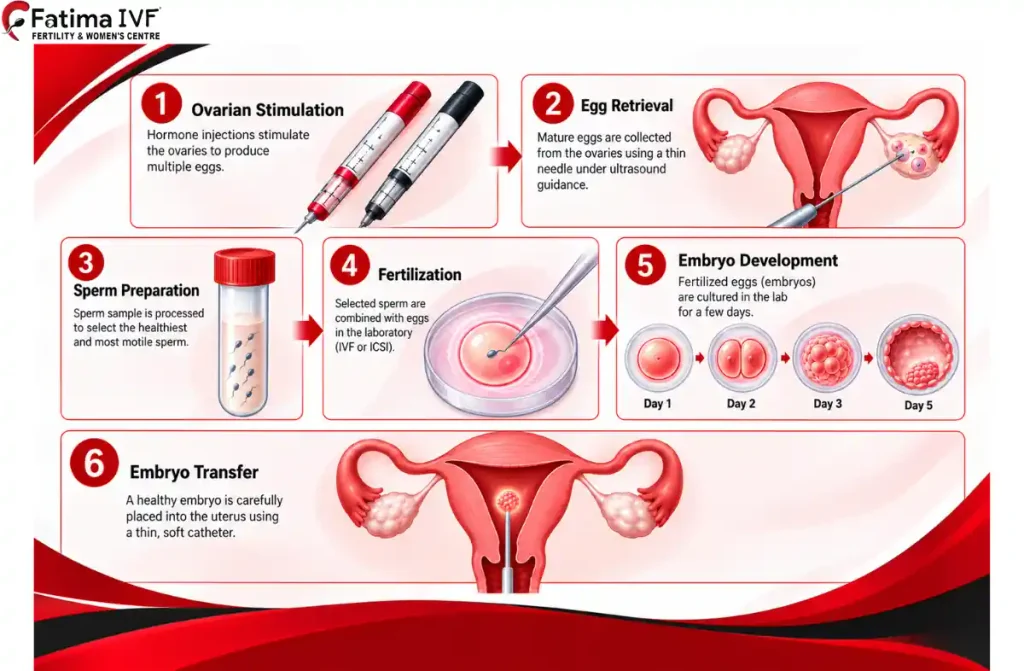
IVF involves collecting eggs from the ovaries and combining them with sperm in a lab, then transferring a resulting embryo back into the uterus. It’s typically recommended when tubes are blocked, when other treatments haven’t worked, or when age is a bigger factor in fertility. The process runs over several weeks and includes hormone stimulation, egg retrieval, lab fertilisation, and embryo transfer, all closely monitored at each stage. Fatima IVF’s lab and clinical team handle every part of this process at the Anna Nagar centre. Dr. Fathimunissa reviews embryo development with you at each step so you always know where things stand.
Intracytoplasmic Sperm Injection (ICSI)
ICSI is a variation of IVF where a single sperm is injected directly into an egg, which helps when sperm count or movement is low. It’s especially useful for male infertility cases that wouldn’t respond well to standard IVF alone. The egg retrieval and embryo transfer steps are the same as IVF; only the fertilisation method in the lab differs. ICSI has become a standard part of fertility labs because it gives couples with male-factor infertility a real path to biological parenthood. Dr. Fathimunissa recommends ICSI specifically when semen analysis results point to it being the better choice.
Male Infertility Treatment
Male infertility accounts for a significant share of cases, yet it’s often overlooked until a couple has tried other things first. Treatment can range from lifestyle changes and medication to hormone therapy or minor surgical procedures, depending on the underlying cause. For more complex cases, sperm retrieval techniques can collect sperm directly for use in ICSI, even when natural sperm count is very low. Dr. Fathimunissa treats male fertility as equally important to female fertility, since both partners contribute to a couple’s overall chances. A proper semen analysis early on often uncovers a straightforward, treatable cause.
Fertility Preservation and Egg Freezing
Fertility preservation lets women freeze eggs, or couples freeze embryos, to use later, whether for medical reasons, career timing, or simply to keep options open. The process involves hormone stimulation similar to the early stage of IVF, followed by egg retrieval and freezing in the lab. This option is also important for patients facing medical treatments, such as certain cancer therapies, that could affect future fertility. Dr. Fathimunissa walks patients through realistic expectations around egg freezing, including how age affects the number and quality of eggs retrieved. It’s a decision many women make years before they’re ready to have children, simply to preserve choice.
When Should You Visit a Fertility Specialist?
Infertility in Women
Female infertility can come from ovulation problems, blocked fallopian tubes, hormone imbalances, or conditions affecting the uterus. If your periods are irregular, painful, or absent, or if you’ve had a past pelvic infection or surgery, these are worth raising early with a specialist. Age also plays a role, since egg quality and quantity naturally decline over time, making earlier evaluation more useful the older you are. A proper workup can usually pinpoint the cause within one or two visits. Dr. Fathimunissa reviews each case individually rather than assuming one common cause fits every patient.
Infertility in Men
Male infertility is usually linked to sperm count, movement, or shape, though hormone imbalances and past surgeries can also play a part. A simple semen analysis is often the fastest way to understand what’s going on, and it’s far less invasive than many people expect. Lifestyle factors like smoking, heavy alcohol use, or prolonged heat exposure can also affect sperm quality and are worth discussing openly with your doctor. Because male infertility contributes to a large share of cases, it deserves the same attention as female evaluation, not an afterthought. Dr. Fathimunissa reviews both partners together so nothing gets missed.
Irregular Periods and Ovulation Problems
Irregular cycles are one of the most common reasons women come in for a fertility consultation, and they often point directly to an ovulation issue. Tracking your cycle length and any missed periods before your visit gives your doctor useful information to work with right away. Ovulation problems are frequently very treatable with medication and monitoring, especially when caught early. Left unaddressed, irregular ovulation can make timing conception harder even without any other underlying issue. Dr. Fathimunissa uses ultrasound tracking across a cycle to confirm exactly what’s happening before recommending treatment.
PCOS and Fertility
Polycystic ovary syndrome, or PCOS, is one of the most common causes of ovulation-related infertility, and it’s highly manageable with the right approach. Treatment usually starts with lifestyle adjustments and medication to support regular ovulation before moving to more involved options if needed. Every case of PCOS looks a little different, so Dr. Fathimunissa builds a plan based on your specific hormone levels and cycle pattern rather than a one-size approach. Many women with PCOS go on to conceive successfully once ovulation is properly regulated. Getting evaluated early gives you more treatment choices and more time to see what works for your body.
Endometriosis and Infertility
Endometriosis can affect fertility by causing scarring or inflammation around the ovaries, tubes, or uterus, which makes conception harder. Symptoms often include painful periods, pain during intercourse, or pelvic pain outside of your cycle, though some women have no symptoms at all. Diagnosis may involve ultrasound imaging and, in some cases, laparoscopy to look directly at the pelvic organs. Depending on severity, treatment can range from medication to surgery to assisted methods like IUI or IVF. Dr. Fathimunissa discusses the full range of options so you understand what fits your specific stage of endometriosis.
Unexplained Infertility
Sometimes all the standard tests come back normal, yet conception still isn’t happening, which is known as unexplained infertility. This diagnosis can feel frustrating, but it doesn’t mean nothing can be done; it usually means the cause is subtle rather than absent. Treatment often starts with simpler options like ovulation tracking or IUI before considering IVF if those don’t lead to a pregnancy. Dr. Fathimunissa takes time to re-examine test results and cycle history closely, since small details are sometimes missed on a first pass. Many couples with this diagnosis do go on to conceive with the right guided treatment.
Fertility Tests and Diagnosis in Anna Nagar
Female Fertility Tests
A female fertility workup usually looks at several things together to build a complete picture:
- Hormone blood tests to check ovarian function and thyroid levels
- Pelvic ultrasound to examine the uterus, ovaries, and follicle count
- Tubal patency tests to check whether the fallopian tubes are open
- Cycle tracking to confirm whether and when ovulation is happening
Male Fertility Tests
Male fertility testing is more straightforward and usually starts with a semen analysis, alongside a general health and hormone review:
- Semen analysis to check sperm count, movement, and shape
- Hormone blood tests when count or motility is low
- Scrotal ultrasound if a structural issue like varicocele is suspected
- Genetic testing in select cases with very low or absent sperm count
Hormonal Tests and Ultrasound
Hormone testing and ultrasound work together to show what’s happening inside the body at different points in a cycle. Blood tests measure levels of hormones like FSH, LH, AMH, and thyroid hormones, all of which affect ovulation and egg development. Ultrasound scans, done at specific points in the cycle, track follicle growth and confirm ovulation timing in real time. These two tools together give Dr. Fathimunissa a much clearer picture than either test alone would provide. Repeating scans across a cycle, rather than relying on a single snapshot, often reveals patterns that guide the treatment plan.
Semen Analysis
Semen analysis remains the single most useful first test for male fertility, since it directly measures sperm count, movement, and shape. It’s a simple lab test that requires a short abstinence period beforehand for accurate results. If results come back below normal ranges, a repeat test is usually done a few weeks later, since sperm quality can vary. Based on these results, Dr. Fathimunissa can recommend anything from lifestyle changes to specific treatments like ICSI. This test alone often shortens the diagnostic process significantly for couples trying to understand male-factor infertility.
Ovarian Reserve Testing
Ovarian reserve testing estimates how many eggs a woman has remaining, which helps guide the urgency and type of treatment recommended. The main test used is AMH, a blood test that can be done on any day of the cycle, alongside an antral follicle count on ultrasound. Lower ovarian reserve doesn’t mean pregnancy isn’t possible, but it does often mean treatment decisions benefit from being made sooner rather than later. Dr. Fathimunissa explains these results in plain terms and how they specifically affect your options. This test is especially useful for women considering fertility preservation or planning treatment timing around age.
Cost of Fertility Treatment in Anna Nagar
Fertility Consultation Cost
Consultation costs at fertility clinics generally cover the doctor’s initial review, discussion of your history, and a plan for next steps. Costs vary depending on whether basic tests are included in the same visit. The clearest way to know exact pricing is to call or WhatsApp the Anna Nagar clinic directly, since fees can be discussed upfront before you book.
IUI Treatment Cost
IUI is one of the more affordable fertility treatments, since it doesn’t involve lab-based fertilisation or an operating theatre. The total cost usually depends on the medication used for ovulation stimulation and the number of monitoring visits required. Fatima IVF is transparent about pricing before starting treatment, so you know the full cost breakdown ahead of time rather than being surprised later.
IVF Treatment Cost
IVF costs more than IUI because it involves hormone medication, egg retrieval, lab fertilisation, and embryo transfer as separate stages. Pricing can also vary based on whether ICSI, genetic testing, or embryo freezing are added to a standard IVF cycle. Fatima IVF shares a clear cost estimate with each patient before treatment begins, so you can plan financially with confidence rather than guesswork.
Factors Affecting Fertility Treatment Costs
Several things influence the final cost of fertility treatment, and it helps to understand them before you start:
- The type of treatment chosen, from ovulation induction up to IVF or ICSI
- Whether additional procedures like laparoscopy or hysteroscopy are needed first
- The number of cycles required to achieve a pregnancy
- Any add-on services such as genetic testing or fertility preservation
- Medication doses, which can vary from person to person based on response
Why Choose a Fertility Specialist in Anna Nagar?
Convenient Location and Accessibility
Fatima IVF’s Anna Nagar clinic sits at No. 1587, 6th Avenue, Chennai 600040, directly opposite SBI Bank, making it an easy landmark to find. The location works well for patients across Chennai, whether commuting from nearby neighbourhoods or travelling in for the day, since it’s a short distance from major roads and public transport. Appointments can be booked by phone or WhatsApp, and the clinic also has a second location in Triplicane for patients on that side of the city. Having a well-known, central address matters during fertility treatment, since some cycles require frequent short visits for monitoring. Easy access reduces one more source of stress during an already demanding process.
Personalized Fertility Treatment Plans
No two fertility cases are identical, even when the diagnosis sounds similar on paper. Dr. Fathimunissa builds each treatment plan around your specific test results, age, and personal circumstances rather than following a fixed protocol. This means two patients with PCOS, for example, might follow different treatment paths based on how their bodies respond. Personalized planning also extends to pacing; some patients want to move quickly to IVF, while others prefer to try simpler options first, and both approaches are respected. This individual attention is often what patients mention most when describing their experience at the clinic.
Advanced Fertility Care
Beyond the standard treatments, Fatima IVF offers advanced procedures for more complex cases, including techniques that support sperm selection and embryo assessment during IVF. These tools are especially useful for couples who haven’t had success with standard treatment elsewhere. Having advanced options available locally in Anna Nagar means patients don’t need to travel to a different city for specialised care. Dr. Fathimunissa recommends these advanced techniques only when your specific case would genuinely benefit from them, not as a default upgrade. This keeps treatment focused on what actually helps your chances, rather than adding cost without reason.
Comprehensive Support Throughout Treatment
Fertility treatment involves more than medical procedures; it also involves ongoing questions, emotional ups and downs, and logistics around appointments and medication. The team at Fatima IVF stays involved at each step, from the first consultation through pregnancy confirmation and beyond, since many patients continue their pregnancy care at the same centre. Staff are available to answer questions between appointments, which matters when a new symptom or concern comes up unexpectedly. This continuity of care, rather than being passed between different providers, helps patients feel supported through what can be a long process. Dr. Fathimunissa and her team aim to be a steady presence throughout, not just during procedures.
Conclusion
Choosing a fertility specialist is a significant decision, and having the right information makes it easier. Dr. Fathimunissa and the team at Fatima IVF’s Anna Nagar clinic offer a full range of fertility evaluation and treatment options, from simple ovulation support to advanced IVF and ICSI, all guided by a personalized plan for each patient. Whether you’re just starting to explore your options or ready to begin treatment, the clinic’s central Anna Nagar location and transparent approach to cost and care make it a practical first call. Reach out by phone or WhatsApp to book a consultation and get clear answers about your specific situation.