An ectopic pregnancy is a pregnancy that starts growing outside the womb, most often inside a fallopian tube. It cannot continue normally, and it can become dangerous if it is not found in time. If a doctor has told you this may be happening, or you have pain and bleeding in early pregnancy, you are probably looking for clear answers. This guide explains how ectopic pregnancy treatment works, how doctors diagnose the condition, and what recovery can look like. It is general information, not a diagnosis. Only a doctor who examines you can say what is happening and which care is right for you.
What Is Ectopic Pregnancy Treatment?
Ectopic pregnancy treatment ends or removes a pregnancy that is growing outside the uterus, so it does not put the mother’s health at risk. Depending on the case, doctors may monitor closely, give a medicine called methotrexate, or perform keyhole (laparoscopic) surgery. The choice depends on symptoms, scan findings, pregnancy hormone (β-hCG) levels and overall health.
Sadly, an ectopic pregnancy cannot continue to a healthy birth. That is why timely assessment matters.
What Is an Ectopic Pregnancy?
In a normal pregnancy, the fertilised egg travels down the fallopian tube and settles in the lining of the uterus. In an ectopic pregnancy, the egg implants somewhere else. The large majority occur in a fallopian tube. Less often, they occur in the cervix, an ovary, a caesarean scar or the abdomen.
Outside the uterus, there is no space or tissue that can support a growing pregnancy. As it grows, it can stretch or damage the structure it is attached to. A fallopian tube can rupture and cause internal bleeding. This is why a doctor needs to check early pregnancies when there is pain or bleeding.
What Are the Symptoms of an Ectopic Pregnancy?
Symptoms often appear a few weeks after a missed period. Common ones include:
- Pain low in the abdomen or pelvis, often on one side
- Vaginal bleeding or spotting that differs from your usual period
- A missed period or a positive pregnancy test
- Pain at the tip of the shoulder
- Dizziness, weakness or fainting
Symptoms vary from woman to woman. Some have mild signs at first. Many of these symptoms can also come from other conditions, including a miscarriage or an infection. Having one of them does not mean you have an ectopic pregnancy. It means a doctor should look into it.
How Is an Ectopic Pregnancy Diagnosed?
Diagnosis usually combines several steps:
- Medical history and examination. The doctor asks about your periods, symptoms and past history, and checks your abdomen.
- Pregnancy test. A urine or blood test confirms that you are pregnant.
- β-hCG blood test. This measures the pregnancy hormone. The doctor looks at the level and at how it changes over time.
- Transvaginal ultrasound. This scan shows whether a pregnancy is visible inside the uterus and checks the tubes and ovaries.
- Repeat tests. In very early pregnancy, a scan may not show clearly where the pregnancy is. Your doctor may repeat blood tests and scans over a few days.
Because of this, the diagnosis is not always made at the first visit. If you are asked to return for repeat tests, go. Those tests help your doctor see what is really happening.
What Are the Treatment Options for Ectopic Pregnancy?
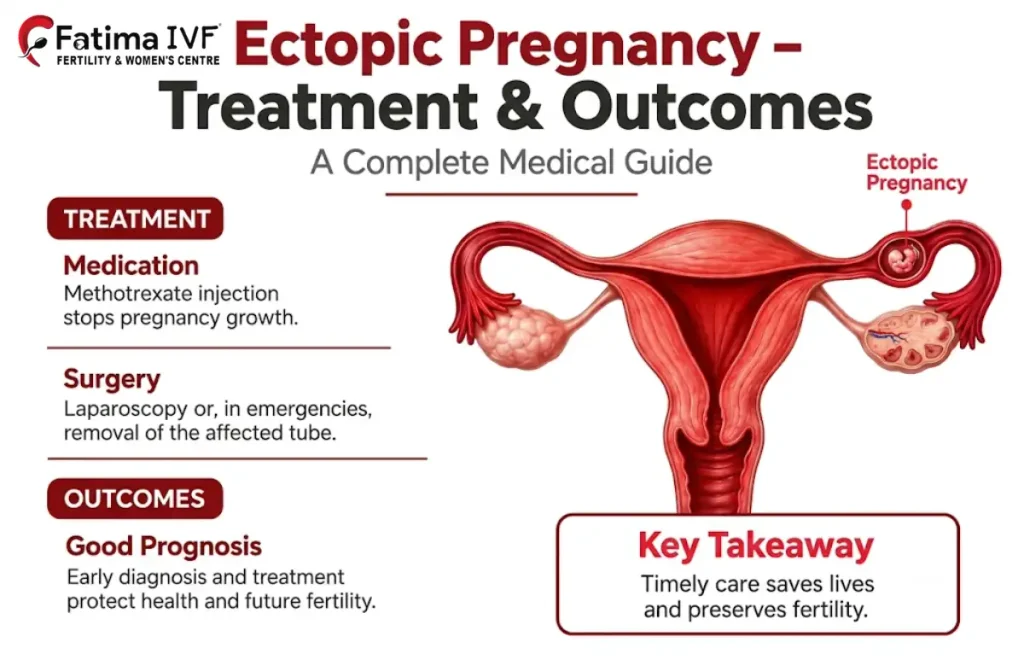
There are three main approaches. Not every approach suits every woman.
Expectant Management
Here, the doctor watches closely with repeat blood tests and does not treat straight away. This may be considered only when the woman is stable, has few symptoms and the β-hCG level is low and falling. Some early ectopic pregnancies settle by themselves. Close follow-up is essential, and treatment may be needed if the level does not fall or symptoms start.
Medical Treatment
Methotrexate is a medicine that stops the pregnancy cells from growing. It is usually given as an injection. It may be considered when the ectopic pregnancy is detected early, the woman is stable, and she can return for regular blood tests. Your doctor decides eligibility after checking your health and test results. The dose is calculated by the doctor for each patient, and it should never be taken without medical supervision.
After methotrexate, you will need follow-up blood tests until the hormone level drops. Some women need a second dose, or surgery if the treatment does not work. Doctors usually advise using reliable contraception for a period afterwards, because the medicine can harm a new pregnancy. Your doctor will tell you how long.
Surgical Treatment
Surgery is usually advised when there is heavy pain or bleeding, when a tube may have ruptured, when the pregnancy is larger or when medicine is not suitable. Most surgery is done through keyhole (laparoscopic) surgery, using small cuts in the abdomen. Sometimes open surgery is needed, especially in an emergency.
How Does a Doctor Decide Which Treatment Is Suitable?
Ectopic pregnancy treatment is never one-size-fits-all. Your doctor may consider:
- Your symptoms, and whether there are signs of internal bleeding
- The location and size of the pregnancy on ultrasound
- Your β-hCG level and whether it is rising, steady or falling
- Your overall health and previous medical or surgical history
- Whether you can attend follow-up visits reliably
- Your wish for future pregnancy
Two women with an ectopic pregnancy may need very different care. Do not compare your plan with someone else’s.
What Happens During Ectopic Pregnancy Surgery?
The surgery is done under general anaesthesia. In laparoscopic surgery, the surgeon makes small cuts and passes a thin camera and instruments into the abdomen. The surgeon then removes the pregnancy. Depending on what is found, this may mean:
- Opening the tube and removing the pregnancy, leaving the tube in place, or
- Removing the affected tube
The choice depends on how damaged the tube is, the state of the other tube and your fertility plans. Your surgeon should explain this before the procedure where possible. Keyhole surgery generally means smaller cuts than open surgery, but recovery still differs from person to person.
What Is Recovery Like After Ectopic Pregnancy Treatment?
Recovery depends on the treatment you had. There is no single timeline.
- Follow-up. After medicine, regular blood tests are needed until the hormone level returns to normal. After surgery, your doctor may also arrange checks.
- Physical recovery. Some pain, tiredness or light bleeding can occur. Your doctor will tell you what is expected and what is not, and when to resume work, exercise and intimacy.
- Emotional recovery. Losing a pregnancy is painful, even when it was not expected to continue. Sadness, anxiety and guilt are common. Talk to your partner, family or doctor, and ask for counselling if you need it.
- Doctor’s instructions. Follow them, including appointments and tests, even if you feel well.
Can You Get Pregnant After an Ectopic Pregnancy?
Many women do go on to have a healthy pregnancy after an ectopic pregnancy. But it cannot be promised. Your chances depend on:
- The health of your remaining fallopian tube(s)
- Your earlier fertility history
- Your age
- Other conditions, such as endometriosis or past pelvic infection
- Earlier surgery or treatment
Having had one ectopic pregnancy raises the chance of another. So in your next pregnancy, tell your doctor early and ask for an early scan to confirm the pregnancy is in the uterus. If conceiving is difficult, a fertility specialist can review your options.
When Should You Seek Medical Attention?
See a doctor promptly if you are pregnant, or think you might be, and have pain in the lower abdomen or pelvis, unusual bleeding, or shoulder-tip pain.
Go to the nearest hospital emergency department straight away if you have:
- Severe or sudden abdominal pain
- Dizziness, fainting or feeling very weak
- Pale, clammy skin or a rapid heartbeat
- Heavy bleeding
These can be signs of internal bleeding and need urgent care. Do not wait for an appointment.
Ectopic Pregnancy Treatment in Chennai
Women in Chennai can have an early pregnancy checked by an obstetrician-gynaecologist through a clinical examination, blood tests and an ultrasound. If you have severe pain, heavy bleeding or fainting, go to the nearest hospital with emergency services instead of waiting for a clinic visit.
Fatima IVF Fertility & Women’s Centre is led by Dr. Fathimunissa, a fertility and IVF specialist and obstetrician-gynaecologist. The centre offers gynaecology care, pregnancy care and laparoscopy, and has branches in Anna Nagar and Triplicane. For non-emergency questions, such as pregnancy concerns or care and fertility planning after an ectopic pregnancy, you can book a consultation or call +91 91766 24850. Please confirm the care available for your situation with the centre directly.
Conclusion
Ectopic pregnancy treatment depends on early checks, the right tests and a plan made for your situation. It can feel frightening, but timely care protects your health and your chances of a future pregnancy. If something feels wrong, get examined without delay.
This article is for general education and does not replace advice from your doctor.